Structural Drying in Austin TX
Complete structural moisture elimination
Professional structural drying in Austin TX using industrial air movers, desiccant dehumidifiers, and daily moisture monitoring to completely dry your home or business.
About Our Structural Drying Service
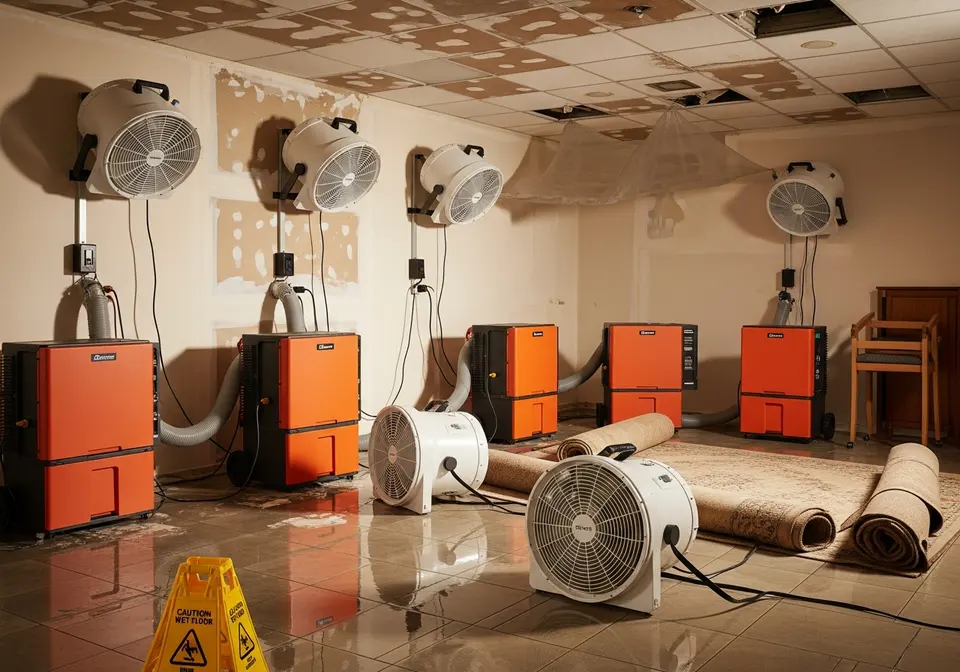
Structural drying is the process of removing moisture from the structural components of a building — walls, floors, ceilings, framing, and subfloor materials — after water damage. Proper structural drying is critical to prevent mold growth, prevent structural damage, and ensure the long-term integrity of your property. Simply opening windows and running fans is completely inadequate. Professional structural drying uses commercial-grade LGR (Low Grain Refrigerant) dehumidifiers and high-velocity air movers that are specifically engineered to remove moisture from building materials. We calculate the exact number and placement of drying equipment based on the affected area, material types, and current moisture readings. Daily monitoring with calibrated moisture meters tracks progress until all materials reach acceptable moisture levels per IICRC standards.
The physics of structural drying are precise. IICRC-certified technicians use psychrometric calculations — factoring in temperature, relative humidity, and airflow — to determine the exact equipment needed to dry a structure efficiently. Too few dehumidifiers and drying takes longer than necessary, increasing the mold risk window. Too many and you may overdry certain materials. Getting it right requires training, experience, and calibrated instruments.
Wall cavity drying is one of the most technically challenging aspects of structural drying. Water penetrates into wall cavities through electrical outlets, gaps, and seams, and it can pool at the bottom of the cavity on the bottom plate. Without specialized injection drying equipment — which pumps warm dry air directly into wall cavities — this moisture has no escape path and will cause mold inside the wall. We deploy injection drying systems on virtually every job where walls are affected.
Austin's climate adds complexity to structural drying. Summer outdoor humidity in Austin regularly exceeds 70-80%, which means bringing in outside air for drying can actually add moisture to a structure rather than remove it. Our LGR dehumidifiers are designed to work in high-humidity environments, pulling moisture out of the air and building materials regardless of outdoor conditions.
Insurance companies require specific drying documentation before authorizing repair work. Our daily moisture logs document each material's moisture content from initial assessment through final drying verification, with the measuring location, meter type, and technician name recorded for each reading. This documentation meets all major carrier requirements and ensures you receive full coverage for the restoration work that follows.
Common Scenarios in Austin, TX
Water-soaked walls require a decision: dry in place using injection drying or remove and replace. We make this determination based on moisture levels, contamination, and material condition.
Water under flooring saturates subfloor panels and wood joists. Without proper drying, wood rot and mold develop within days. Mat drying systems address this without removing flooring.
Roof leaks saturate attic insulation and roof decking. Replacing insulation and drying the structure completely prevents the mold growth common in wet Austin attics.
Large commercial spaces require industrial-scale drying equipment and psychrometric planning. Our commercial division handles high-volume structural drying projects throughout Austin.
What's Included
Our Structural Drying Process
Calibrated moisture meters and thermal imaging map all wet areas and materials.
We calculate the required number of air movers and dehumidifiers per IICRC standards.
Air movers and dehumidifiers are strategically positioned for maximum drying efficiency.
Injection drying or mat drying systems are used for walls, floors, and other hard-to-reach areas.
Technicians return daily to record moisture readings, adjust equipment, and document progress.
Final moisture readings confirm all materials meet IICRC drying standards before equipment removal.
Important Warnings
- Incomplete drying causes mold growth inside walls weeks after an event
- Structural components must reach specific moisture content levels per IICRC standards
- Consumer dehumidifiers lack the capacity for effective structural drying
- Drying time varies — rushing the process results in hidden moisture and future problems
Frequently Asked Questions
Need Structural Drying Right Now?
We respond in 60 minutes or less to all Austin area emergencies, 24/7/365.
Get Free Inspection & Estimate
We respond within 60 minutes. Available 24/7.
All Services
Insurance Approved
We work with all major carriers and handle your complete claim.