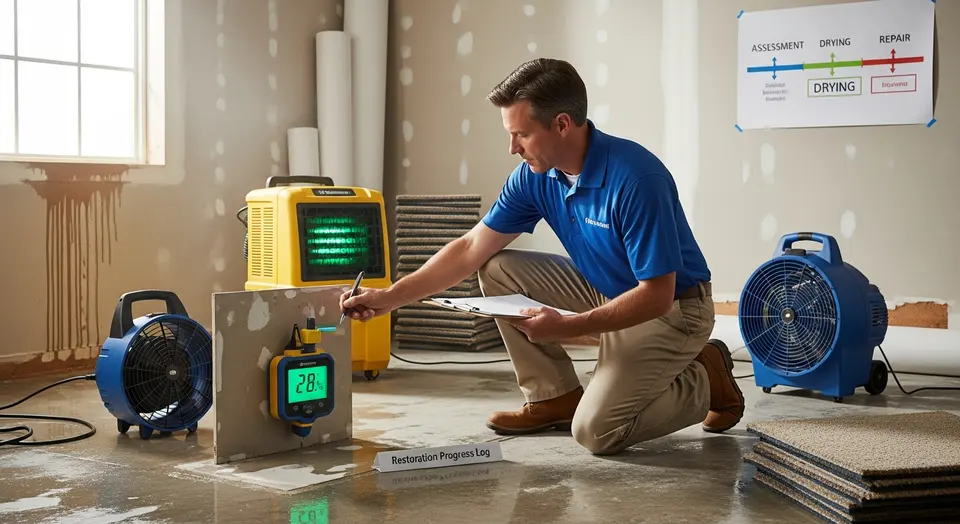
One of the first questions homeowners ask is how long the process takes. The honest answer depends on several factors — but here's a realistic timeline for every stage of professional water damage restoration.
When water damage disrupts your home or business, one of the first questions is: how long will this take? The honest answer is that it depends on the severity of damage, water category, affected materials, and ambient conditions. But a realistic timeline helps you plan, set expectations with your family or business, and understand why professional restoration takes the time it does — and why rushing it creates expensive problems.
Day 1: Emergency Response (Hours 1–8)
From the time you call to the completion of initial emergency services, expect 4–8 hours of active work on Day 1. This includes arrival and setup (typically within 60 minutes of your call), complete inspection and documentation, water extraction (1–3 hours depending on volume), initial drying equipment placement, and insurance documentation setup. By end of Day 1, the water is extracted and equipment is running.
Days 2–5: The Drying Phase
This is the phase most homeowners don't anticipate. Even after extraction, significant moisture remains absorbed in building materials — drywall, subfloors, framing, insulation. Industrial drying equipment must run continuously, typically for 3–5 days, to bring materials back to acceptable moisture levels. A technician will visit daily to take moisture readings, adjust equipment placement, and monitor progress. The drying phase cannot be rushed — cutting it short is the most common cause of mold growth after restoration.
The IICRC S500 standard defines 'dry standard' as moisture content comparable to unaffected materials in the same structure. This is measured with moisture meters — not estimated by feel or appearance.
Equipment Removal
Once moisture readings confirm materials have reached dry standard, equipment is removed. This is typically Day 3–6 for a Class 2 loss and Day 4–7 for a Class 3 loss. For more complex losses involving hardwood floors, concrete slabs, or specialty materials, drying can take 7–10 days or longer.
Reconstruction Phase
After drying is complete, any materials that needed to be removed — drywall, flooring, insulation — are replaced. For a basic loss this might be 2–3 days of work. For a more extensive loss affecting multiple rooms, reconstruction can take 2–6 weeks. This phase is often coordinated with your insurance adjuster to ensure all scope of work is approved before proceeding.
- Minor drywall repair: 1–2 days
- Room drywall replacement: 2–4 days
- Flooring replacement (one room): 1–3 days
- Multi-room flooring: 1–2 weeks
- Full kitchen or bathroom reconstruction: 4–8 weeks
Total Timeline Summary
For a typical Class 2 water loss (one room, burst pipe, clean water):
- Day 1: Emergency response, extraction, equipment setup
- Days 2–4: Active drying, daily moisture monitoring
- Day 5: Equipment removal (if dry)
- Days 6–10: Minor repairs and restoration
- Total: 1–2 weeks start to finish
Why You Can't Rent Equipment and DIY the Drying
Consumer-grade dehumidifiers and fans are not designed for structural drying. They lack the airflow capacity, dehumidification rate, and control necessary to dry building assemblies in a timely manner. Using insufficient equipment extends the drying time significantly — often enough to allow mold growth — and does not produce the documentation (daily moisture readings) required by insurance companies. Professional equipment is essential.
A certified water damage restoration professional at Austin TX Water Damage, serving Central Texas homeowners and businesses with expert restoration services.
24/7 Emergency Service
Water damage emergency? We respond in 60 minutes, any time of day or night.
(512) 222-8357